



Author
Ahmed Barakat
Author

Share

Fact Checked by
CryptoNews Editorial Team
Author

The White House has reached an agreement on the Clarity Act ethics provision, the main sticking point blocking a Senate floor vote, and has begun circulating deal language with Republican senators, according to Eleanor Terrett.
The agreement removes what had been the single biggest procedural overhang on the legislation, but the bill still faces a compressed timeline and a 60-vote cloture threshold.
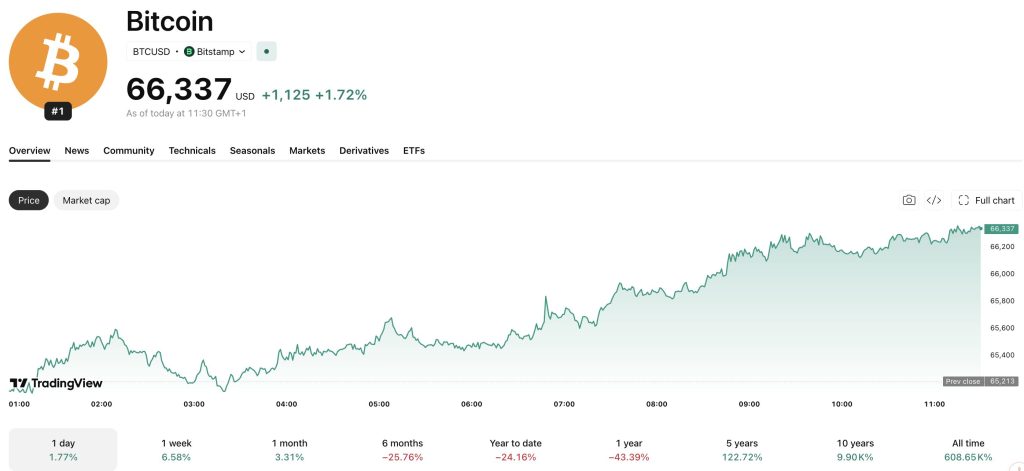
This latest CLARITY Act development comes as the crypto market is bouncing hard, with Bitcoin leading the charge after reclaiming $66,000 on the back of a +3.5% daily move and $31.5Bn in trading volume.
Why the Ethics Provision Stalled the CLARITY Act Bill
The ethics provision at the center of the dispute is designed to prevent senior officials from holding or profiting from digital assets they are responsible for regulating – a structural conflict-of-interest bar that Democrats made a hard condition of their support. The political charge intensified after an Office of Government Ethics disclosure.
The White House’s negotiating position, previously articulated by crypto adviser Patrick Witt, held that any ethics language must apply uniformly rather than targeting the president or his family specifically.
A prior compromise involving state attorneys general as enforcers collapsed after Democrats rejected it as inadequate, and a Senate committee amendment from Sen. Chris Van Hollen failed 13–11 along party lines. The July 20 agreement suggests the two sides found language that threads that needle, though the specific text has not been publicly released.
The Clarity Act is built around establishing a comprehensive federal market-structure framework for digital assets, codifying key elements of US crypto market regulation. It passed the House in July 2025 and cleared the Senate Banking Committee in May 2026.
The bill still needs additional steps before a floor vote can occur. That ethics provision deadlock had driven Senate passage odds into the 40–45% range by late June.
Discover: The Best Crypto to Diversify Your Portfolio
The Legislative Window Is Now Measured in Days
The Senate heads into its August recess after the first week of August, leaving only a matter of weeks for the chamber to process and vote on the legislation this year.
That August deadline has been the defining constraint on the bill’s timeline since spring, and if no vote occurs before the recess, momentum likely slips into 2027. The agreement on the ethics provision is necessary to unlock floor scheduling, but it is not sufficient.
The bill still needs additional steps before a floor vote can occur. The 60-vote threshold means Democratic senators must cross, and the deal language now being shared with Republican senators will need to satisfy Democratic holdouts.
What Passage Would Mean for Markets
For active traders, the main implication of the passage is regulatory clarity for US exchanges, issuers, and investors. A defined federal framework can reduce legal uncertainty and encourage broader institutional adoption.
Failure carries the inverse risk: if the bill stalls again, regulatory uncertainty extends well into next year, and the political window for a comprehensive market structure bill narrows further.
The ethics agreement meaningfully shifts the probability distribution toward passage, but traders should treat the outcome as unresolved until the revised text clears and Democratic floor commitments are on record.
Discover: The Best Token Presales