
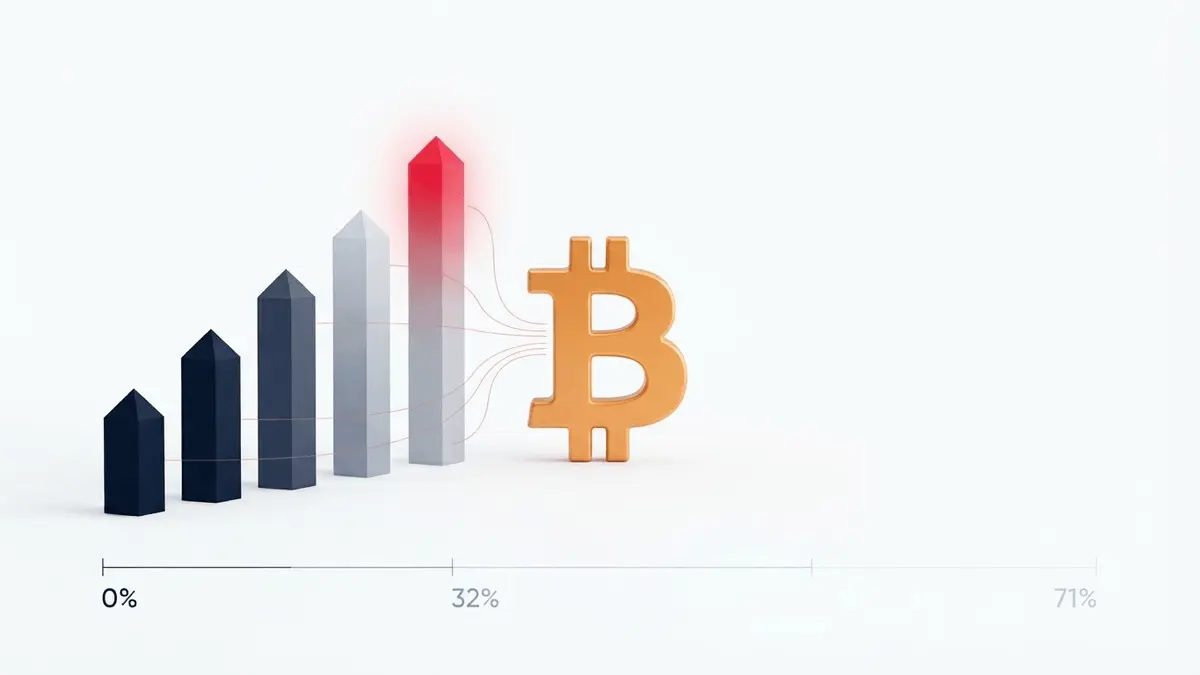

Microstrategy published its Bitcoin Banking Adoption Index on July 13, 2026, scoring 25 of the world’s largest banks on how deeply they have wired Bitcoin into their business.
The headline number is 32%, meaning the biggest institutions on the planet are, by Strategy’s own measure, roughly one-third of the way toward full institutional Bitcoin adoption. That figure lands while Bitcoin itself traded near $61,900, down more than 3% on the day, a reminder that even with Wall Street gradually moving in, price volatility has not gone anywhere.
We have introduced the Bitcoin Banking Adoption Index.
Major-bank Bitcoin adoption is accelerating, but still early: 32% overall as measured by the index. $BTC https://t.co/bQgyU0DEKp
— Michael Saylor (@saylor) July 13, 2026
The tension this article unpacks: Strategy holds 843,775 BTC, the world’s largest corporate Bitcoin treasury, so it has a direct financial interest in accelerating bank adoption. That conflict does not automatically invalidate the data, the company drew figures from public sources and has invited corrections, but it is a variable every reader should hold in mind before treating the index as a neutral scorecard.
DISCOVER: The Next 1000x Crypto Gem Before It Lists on Binance
What the Microstrategy Bitcoin Index Actually Measures, and How
Think of the Bitcoin Banking Adoption Index as a report card issued to the global banking system. Each of the 25 institutions in the cohort was selected using criteria including total assets, assets under custody, private banking assets, and 2025 G-SIB status, with G-SIB standing for Global Systemically Important Bank, the designation regulators apply to institutions whose failure would threaten financial stability worldwide.
Scoring runs across four categories. Trading and custody cover whether a bank offers direct Bitcoin trading, brokerage, and exchange-traded fund (ETF) execution. Products capture participation in the spot Bitcoin ETF market, stablecoin infrastructure, and tokenization. Lending looks at Bitcoin-backed loans, BTC-as-collateral arrangements, and margin financing against digital assets.
Executive support, the softest but arguably most forward-looking category, tracks public CEO and CFO commentary alongside any corporate Bitcoin treasury allocation.
The scoring mechanism uses a Harvey balls system: five discrete levels from zero implementation to full implementation per category, then blended into a single adoption percentage. Strategy pulled all data from public sources with a cutoff of July 10, 2026, and has been explicit that the figures are approximate. Full category weights, evidence standards, and the complete methodology are still to come, a gap worth flagging, since it limits independent verification for now.
Fidelity’s Eight-Year Head Start Explains the Gap at the Top
Fidelity’s 71% score is not an accident of timing. The firm launched Fidelity Digital Assets, a dedicated institutional custody and trading operation, back in 2018, six years before US regulators approved the first spot Bitcoin ETF inflows began flowing in January 2024. That infrastructure runway meant Fidelity entered the ETF race as an issuer rather than merely a distributor, giving it category-leading scores across custody, products, and executive commitment.

The US bank cluster sits meaningfully behind Fidelity but well clear of the global average. BNY scores 46%, Goldman Sachs 45%, and JPMorgan, Morgan Stanley, and Citigroup each land near 43%. These institutions have built Bitcoin-adjacent services, client trading, futures clearing, ETF custody arrangements, without yet committing to full balance-sheet exposure or lending programs at scale. They bank Bitcoin; they are not yet banking on Bitcoin in the way Strategy does.
For context on how Wall Street has been positioning around Bitcoin ETFs specifically, BlackRock’s IBIT has absorbed enormous institutional demand since launch, a dynamic that pushes custodians and prime brokers up the adoption curve even when their own proprietary exposure remains limited.
DISCOVER: Best Meme Coin ICOs to Invest in 2026
Geography Is the Sharpest Dividing Line
The 13% score for Japan’s SMBC and Canada’s Royal Bank of Canada is not simply a matter of institutional conservatism. Regulatory environment matters enormously here. The US moved to approve spot Bitcoin ETFs in January 2024, creating a product category that directly lifts scores in the trading, custody, and products buckets. Japan and Canada have taken more cautious approaches to retail-accessible Bitcoin products, which flows directly into lower institutional infrastructure build-out at the bank level.
European lenders sitting near 35% reflect a middle path: the EU’s Markets in Crypto-Assets regulation (MiCA, the bloc’s comprehensive framework governing digital asset service providers) has given banks a clearer compliance runway than existed before 2024, but the product suite remains narrower than the US offers. Banco Santander and Société Générale have made moves in custody and tokenization, enough to clear the global average, but not enough to close the gap on US peers who have benefited from a more permissive spot ETF regime.
This geographic divergence aligns with findings from Henley & Partners’ 2025 Crypto Adoption Index, which ranks jurisdictions on six parameters, including infrastructure adoption and regulatory environment, and consistently places the US and select European hubs ahead of Canada and Japan on banking and capital-markets infrastructure maturity.
EXCLUSIVE: Earn $10 USDC Via Binance Sign-Up

Why you can trust 99Bitcoins
Established in 2013, 99Bitcoin’s team members have been crypto experts since Bitcoin’s Early days.
90hr+
Weekly Research
100k+
Monthly readers
50+
Expert contributors
2000+
Crypto Projects Reviewed


Follow 99Bitcoins on your Google News Feed
Get the latest updates, trends, and insights delivered straight to your fingertips. Subscribe now!